


In the fitness industry, scaling a gym from a startup to a thriving enterprise requires careful planning and awareness of potential pitfalls. Jason Fernandez (aka "Fern"), co-creator of Best Hour of Their Day breaks down the key phases of business growth, highlighting revenue milestones, member counts, and critical risks that can make or break success.
This overview is particularly relevant for gym owners and fitness professionals looking to expand their operations. Whether you're just starting out or aiming for multi-location dominance, understanding these stages can help you build a more resilient business.
The Seven Phases of Growth
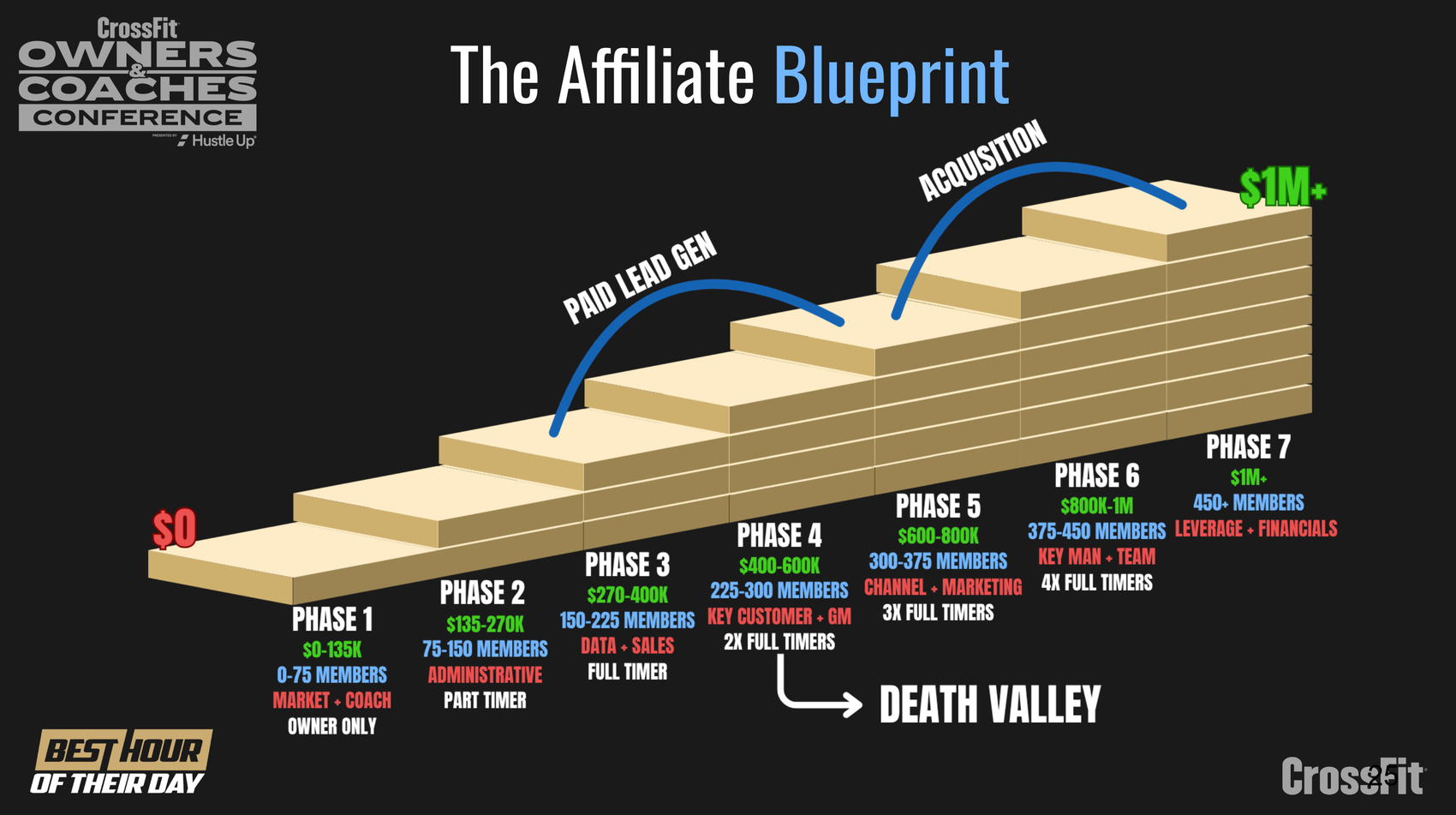
Fern outlines seven distinct phases of business growth, each defined by revenue ranges and member counts. These phases provide a roadmap for gym owners to track progress and anticipate challenges:
- Phase 1-3: Early stages focus on building a foundation, with revenue typically under $400K and fewer than 100 members. Here, the emphasis is on establishing viability and basic operations.
- Phase 4: Often referred to as "Death Valley," this phase sees revenue between $400K-$600K and 100-150 members. It's a critical transition where many gyms falter due to inefficiencies.
- Phase 5-7: Mature stages are above $600K and push toward $1M in revenue and 300+ members, involving advanced strategies like multi-location expansion and optimized systems.
Throughout these phases, Fern uses the chart below to map out team structures (in white) and risks (in red), emphasizing how roles evolve from owner-operated to a full management team.
Identifying and Mitigating Risks
A core part of the discussion revolves around macro and micro risks that evolve as the business scales. Macro risks address big-picture challenges, while micro risks focus on internal roles and operations. Key risks highlighted include:
- Market Risk: Relevant in early phases or startups, this involves assessing if the location can sustain the business—factoring in real estate costs, demand, and competition.
- Administrative Risk: A lack of systems and processes to handle daily operations, which can lead to chaos as the gym grows.
- Data Risk: Becomes prominent around Phase 3. Without accurate data on budgets, customer acquisition costs, or lifetime gross profit, decision-making suffers. Fern notes that unsolved data issues often lead to "financial leaks" in Phase 4.
- Key Customer Risk: Dependence on a small group of high-revenue clients (e.g., 7-10 personal training clients accounting for 25-30% of revenue) introduces vulnerability. He advises treating these as profit centers only if they're high-margin and low-risk.
- Channel Risk: Relying on a single lead source, like a website, limits growth. Diversifying to include referrals, paid ads, and outbound activities is essential for stability.
- Key Man Risk: Over-reliance on individuals (e.g., the owner, GM, or marketing lead). By Phase 7, a full management team should be in place to ensure the business runs independently.
- Leverage Risk: In later phases, this concerns access to capital—being under- or over-leveraged can hinder valuation and expansion.
By addressing these risks proactively, gym owners can avoid common traps and position their business for sustainable growth.
Surviving "Death Valley" in Phase 4
Phase 4 earns its ominous nickname because many gyms hit a wall here. With solid revenue but unresolved issues like poor data management, resources aren't optimized. Without knowing key metrics—such as customer acquisition costs or churn rates—gyms become inefficient, wasting potential reinvestment opportunities. The solution? Invest in robust data systems early to pull the right levers for growth.
The Shift to Paid Lead Generation
As gyms approach 150-225 members, organic leads often can't keep pace with churn (ideally kept at 3-5%). Fern points out that this is when paid lead generation becomes crucial, typically between Phases 3 and 5. Strategies like outbound sales development representatives (SDRs) or enhanced referral processes can help outpace losses and fuel expansion. While some gyms reach Phase 7 without it, it's not the norm—proactive lead gen is key to maintaining momentum.
Scaling Up: Acquisitions and Leverage in Later Phases
For ambitious owners eyeing exits or higher valuations, Phases 5-7 involve strategic moves like owning real estate or acquiring multiple locations. However, Fern warns against rushing into multi-site operations without sufficient cash flow, capital, teams, or optimized systems. Poor customer acquisition at one location multiplies into a "nightmare" across several. Done right, these steps enhance enterprise value and provide flexible exit options, such as M&A deals.
Final Thoughts: Targeting Pain Points for Success
Fern's framework isn't just theoretical—it's a practical tool for diagnosing gym-specific challenges and tailoring solutions. By mapping your business against these phases and risks, you can focus on what matters most at each stage. If you're a gym owner feeling stuck or a fitness pro exploring management roles, this approach can guide your next steps toward stability and scalability.
Interested in learning more? BHOTD has a proven coaching system and process to free affiliate owners from ownership purgatory. Let Fern and his team help you build a growing and sustainable business. Learn more about their Affiliate University here.